I recently stayed at two high-profile luxury hotels in the same North American destination, one immediately after the other. They belong to established international groups, have exactly the same number of rooms and both rely heavily on WhatsApp, and although I had not intended to compare their service models, the difference between the two became impossible to ignore. Both properties will be reviewed in full in an upcoming issue of The Gallivanter’s Guide.
The first had been booked through Trip.com and I received no communication from the hotel before arriving. The second had been booked through my regular travel agent and, before I even reached the property, I had completed a lengthy questionnaire and exchanged several emails with the hotel about why I was travelling, what my favourite wine was and whether I required various things in the room.
I gave them my favourite wine, although nothing was ever said about it again. I was not expecting a complimentary bottle, but I was left wondering why they had asked in the first place. Perhaps the database was curious.
The morning coffee generated considerably more interest. The hotel introduced it separately as one of its morning rituals, which led to an almost comic amount of correspondence about how I wanted it, what sort of milk I preferred and precisely when it should be delivered. I requested strong American coffee with oat milk on the side, everything was confirmed before arrival and then confirmed again once I reached the hotel, at which point I was also told that I had two butlers.
At the first hotel, meanwhile, I had known almost nothing before turning up, yet within minutes of arriving I had met my personal host. She introduced herself, explained when she would be working and told me who would take over in her absence, which meant that, oddly enough, it was at the hotel that knew least about me beforehand that I always knew exactly who was looking after me.
My host was present without hovering. When I could not find my room key, she replied within two minutes to say that she was on her way; when I needed something collected from another hotel, one of her colleagues went there, collected it and kept me informed; restaurant reservations were made and confirmations sent. Several people clearly had access to the WhatsApp account, but everyone gave their name, and when my host was not working I knew who had taken over. It felt like a direct line to actual people inside the hotel rather than to an anonymous service channel.
At the second property, I generally saw one of my two butlers no more than once a day and, on one day, neither appeared at all. I never knew when they were working or which one, if either, was replying to me, because the WhatsApp messages were never signed and every answer appeared simply beneath the hotel’s name. I would be told that something was being checked, that someone would investigate or that the team remained attentive, but I had no idea who “I” or “we” actually referred to.
The conversation was being managed through the group’s Salesforce platform, which allows guest information and messages to be shared between staff. Whatever else that meant, I was clearly not simply messaging a telephone carried by one of my butlers.
When I asked the general manager who was actually answering, he repeatedly told me that “everyone” reads WhatsApp.
Everyone where?
The two butlers? Reception? The wider hotel team? A central office?
Even when I suggested that it sounded like a centralised system, I received no clearer answer. I had asked who was replying and was told who could read the messages, which is not quite the same thing.
This would have mattered considerably less had everything worked smoothly, but unfortunately it did not. A request for late checkout, which I was told would be confirmed shortly, took three hours. One evening, shortly after 6 p.m., I received a message asking whether I needed a dinner reservation and, when I did not answer immediately, one of the butlers came to my door, yet the following day I neither saw nor heard from either of them. The system was evidently capable of both intense concern and complete indifference.
Then came the coffee, which after all the questions, emails and repeated confirmations failed to appear the following morning.
When I contacted the hotel through WhatsApp, I was told that the matter would be investigated, yet nobody offered to send the coffee immediately or even asked whether I would still like it brought to my room. That was when I began to wonder who I was actually talking to, because had one of my butlers been sitting inside the hotel reading the message, surely the obvious response would have been to send the coffee first and investigate afterwards. Coffee, after all, rarely benefits from a formal inquiry.
The contrast with the first hotel could hardly have been clearer: it had known nothing about me before I arrived and my host simply got to know me, while the second knew my favourite wine, how I took my coffee and precisely when I wanted it, yet still failed to bring it.
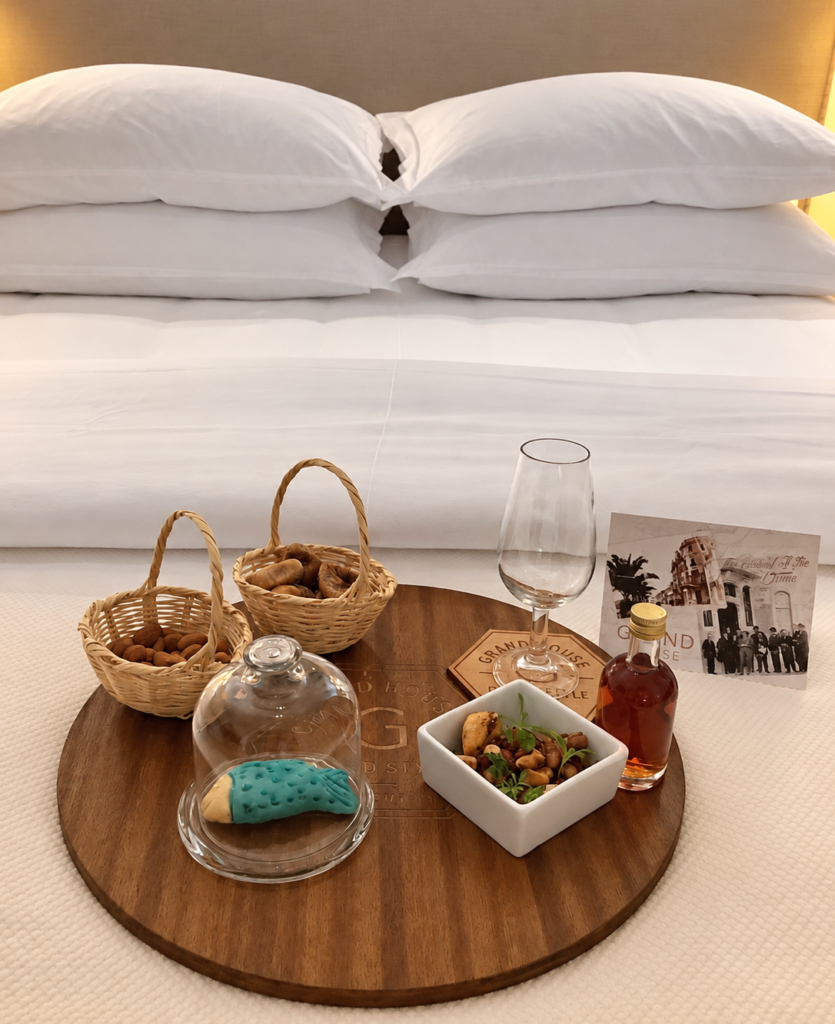
On my final evening, I returned from dinner to find a large ceramic tray and a handwritten card signed by the two people who were presumably my butlers. At last, the anonymous butlers had names.
The note remarked that time flies and said that they wanted me to take a piece of their home with me, which was touching in principle, although time had indeed flown and, after several days, I was still not sure I could have recognised either of them. The tray had also been left entirely unwrapped, so as I was flying the following day I had to ask the hotel to package it safely. It was a lovely gesture, but also a rather appropriate one: a personal note from two people I barely knew, attached to a fragile gift nobody had thought to pack.
I have always been slightly wary of the hotel butler concept, which is a grand title that often seems to mean little more than guest relations with better marketing. I do not need someone hovering around me all day; I simply want to know who is looking after me and who takes over when that person leaves.
If a hotel assigns me two butlers but I cannot identify either of them through the main channel of communication, the title starts to feel rather meaningless. Technology may make certain things quicker and cheaper, but it can also make an already impersonal experience even less human, and while service standards have been eroding since Covid, room rates, oddly enough, have not.
I do not care whether artificial intelligence tells me when the swimming pool opens, but I do care when a hotel replaces a name with a logo and a person with a shared inbox. A quick reply saying that something will be investigated is not the same as someone taking responsibility for it.
With so many CEOs of high-end hotel groups promising to embrace artificial intelligence in order to deliver ever better service, one might reasonably ask whether they have mastered the human version first.
At the first hotel, I had one host and always knew who was looking after me; at the second, I had two butlers and was still asking the general manager who had been answering my messages. If the guest’s closest relationship is with a hotel logo on WhatsApp, that is not butler service.
It is a help desk.